1 / 1

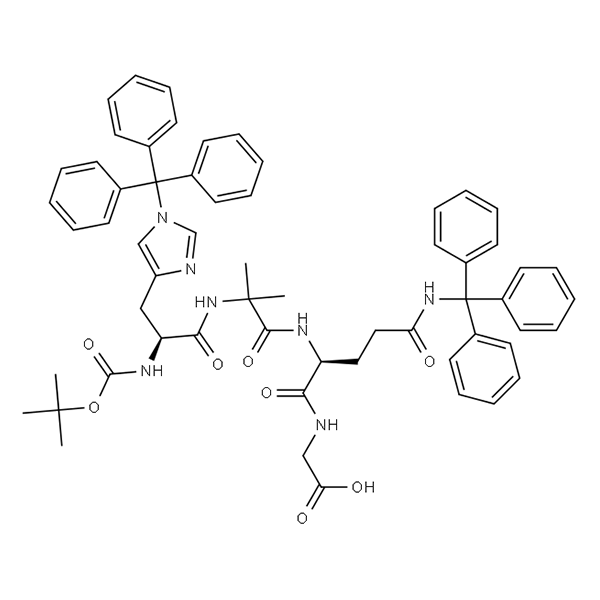
This protected tetrapeptide is used in peptide synthesis and conformational studies. The incorporation of Aib (α-aminoisobutyric acid) allows researchers to investigate helical structures and folding behavior in short peptides. The protected functional groups (Boc, Trt) ensure stability and selectivity during solid-phase peptide synthesis, making it a valuable model for studying peptide backbone dynamics and side-chain interactions.
Boc-His(Trt)-Aib-Gln(Trt)-Gly-OH serves as a model compound for exploring peptide stability and structural motifs. Aib contributes to helical stabilization, while histidine and glutamine residues provide potential interaction sites, useful in designing bioactive peptides or mimicking protein fragments. It can also be a precursor for functional peptides in drug development or biochemical assays.
It is a protected tetrapeptide primarily used as a model compound in peptide synthesis, conformational studies, and structural motif research.
The incorporation of Aib (α-aminoisobutyric acid) contributes to helical stabilization, allowing researchers to investigate peptide folding behavior and helical structures.
The Boc and Trt functional protecting groups ensure stability and chemical selectivity during solid-phase peptide synthesis (SPPS).
Histidine and glutamine residues provide potential side-chain interaction sites, making the compound useful for designing bioactive peptides and mimicking protein fragments.
Yes, it can serve as an important precursor for synthesizing functional peptides applied in drug development and biochemical assays.