1 / 2

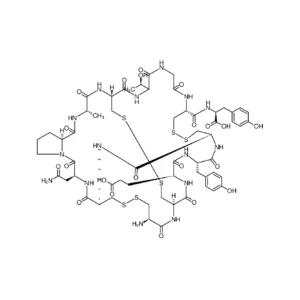
| Name | Leuprorelin |
| CAS number | 53714-56-0 |
| Molecular formula | C59H84N16O12 |
| Molecular weight | 1209.4 |
| EINECS Number | 633-395-9 |
| Specific rotation | D25 -31.7° (c = 1 in 1% acetic acid) |
| Density | 1.44±0.1 g/cm3 (Predicted) |
| Storage condition | -15°C |
| Form | Neat |
| Acidity coefficient | (pKa) 9.82±0.15 (Predicted) |
| Water solubility | Soluble in water at 1mg/ml |
Leuprolide, goserelin, triprelin, and nafarelin are several drugs commonly used in clinical practice to remove ovaries for the treatment of premenopausal breast cancer and prostate cancer. (referred to as GnRH-a drugs), GnRH-a drugs are similar in structure to GnRH and compete with pituitary GnRH receptors. That is, the gonadotropin secreted by the pituitary decreases, which leads to a significant decrease in the sex hormone secreted by the ovary.
It can be used for the drug castration treatment of endometriosis and uterine fibroids, central precocious puberty, premenopausal breast cancer and prostate cancer, and also for functional uterine bleeding that is contraindicated or ineffective for conventional hormone therapy.
At present, the acetate salt of leuprolide is mainly used clinically, because the performance of leuprolide acetate is more stable at room temperature. Liquid should be discarded. It can also be used as a premedication before endometrial resection, which can evenly thin the endometrium, reduce edema, and reduce the difficulty of surgery.
Leuprorelin (Leuprolide) is a gonadotropin-releasing hormone (GnRH) analog and a synthetic peptide composed of 9 amino acids. It is widely used to treat sex-hormone-dependent medical conditions.
Leuprolide competes with pituitary GnRH receptors, suppressing pituitary-gonadal function. This reduces gonadotropin secretion from the pituitary gland, leading to a significant decrease in sex hormone levels.
Leuprolide acetate is primarily used in clinical settings because it demonstrates greater stability at room temperature compared to unformulated alternatives.
It is used for treating premenopausal breast cancer, prostate cancer, endometriosis, uterine fibroids, central precocious puberty, and functional uterine bleeding unresponsive to conventional hormone therapies.
Initially, levels of FSH, LH, estrogen, or androgen may temporarily increase. Over time, pituitary responsiveness decreases, resulting in the desired suppression of these hormones.
It can be administered as a premedication to evenly thin the endometrium and reduce edema, which lowers surgical difficulty.